IEEE Format Research Paper: A Complete Guide
Writing a high-quality research paper requires not only thorough research and critical analysis but also proper formatting. Among the various academic styles, the IEEE format research paper stands out as a preferred choice for engineering, computer science, and technology-related publications. This format is widely recognized for its structured layout, precise citation style, and professional appearance, making it essential for students, researchers, and professionals aiming for publication in IEEE journals or conferences.
Understanding and adhering to the IEEE format ensures that your research is presented clearly, improves readability, and meets the standards expected by peer-reviewed journals. In this article, we will discuss everything you need to know about preparing an IEEE format research paper, including its structure, citation style, and formatting guidelines.
What is the IEEE Format?
The IEEE format refers to the guidelines established by the Institute of Electrical and Electronics Engineers (IEEE) for writing and presenting research papers. This format provides a uniform style for organizing content, referencing sources, and structuring sections in a way that emphasizes clarity, accuracy, and professionalism.
One of the key features of the IEEE format is its in-text citation style, which uses numbers in square brackets to refer to sources, rather than author-date formats commonly used in APA or MLA styles. This numeric citation system streamlines reading, particularly for technical documents where numerous references may be cited in a single paragraph.
Structure of an IEEE Format Research Paper
A well-organized IEEE format research paper typically follows a standardized structure. While minor variations exist depending on the journal or conference, the essential components remain consistent:
1. Title
The title should be concise yet descriptive, clearly reflecting the focus of your research. It is centered at the top of the first page and should use a bold font style. Avoid using abbreviations unless they are widely recognized in your field.
2. Abstract
The abstract is a brief summary of your research, usually between 150-250 words. It should highlight the purpose, methodology, key findings, and conclusion of the study. Since the abstract is often the first section readers look at, make it informative and engaging without delving into detailed data.
3. Keywords
Immediately following the abstract, include 3-5 keywords that accurately represent the main topics of your research. These keywords help readers and databases locate your paper more efficiently.
4. Introduction
The introduction sets the context for your study. It should include background information, a clear statement of the problem, research objectives, and an overview of your approach. Importantly, the first paragraph of your introduction is an ideal place to mention IEEE format research paper as a keyword naturally to establish relevance.
5. Literature Review
In the literature review section, summarize existing research related to your topic. Highlight gaps in knowledge, controversies, or limitations in previous studies. This section provides the foundation for justifying your research methodology and objectives.
6. Methodology
The methodology section details how you conducted your research. Explain your experimental design, data collection procedures, and analysis techniques. A well-documented methodology allows other researchers to replicate your study and validates the reliability of your results.
7. Results
Present your research findings using tables, figures, and graphs as necessary. IEEE format encourages the use of clearly labeled visuals to support your data. Each figure or table should have a number and a descriptive caption.
8. Discussion
In this section, interpret your results, discuss their implications, and compare them with prior studies. Highlight any limitations or unexpected outcomes and provide possible explanations. This section connects your findings to the broader field of study.
9. Conclusion
The conclusion summarizes the main findings, emphasizes the significance of your research, and suggests directions for future studies. Keep it concise and focused, reinforcing the key messages of your paper.
10. References
All sources cited in your paper must appear in the reference list at the end. In IEEE format, references are numbered in the order they appear in the text, not alphabetically. Each reference includes details such as author(s), title, journal or conference, volume, issue, page numbers, and publication year.
Formatting Guidelines for IEEE Research Papers
Proper formatting is crucial for making your paper professional and publication-ready. Here are the essential IEEE formatting rules:
-
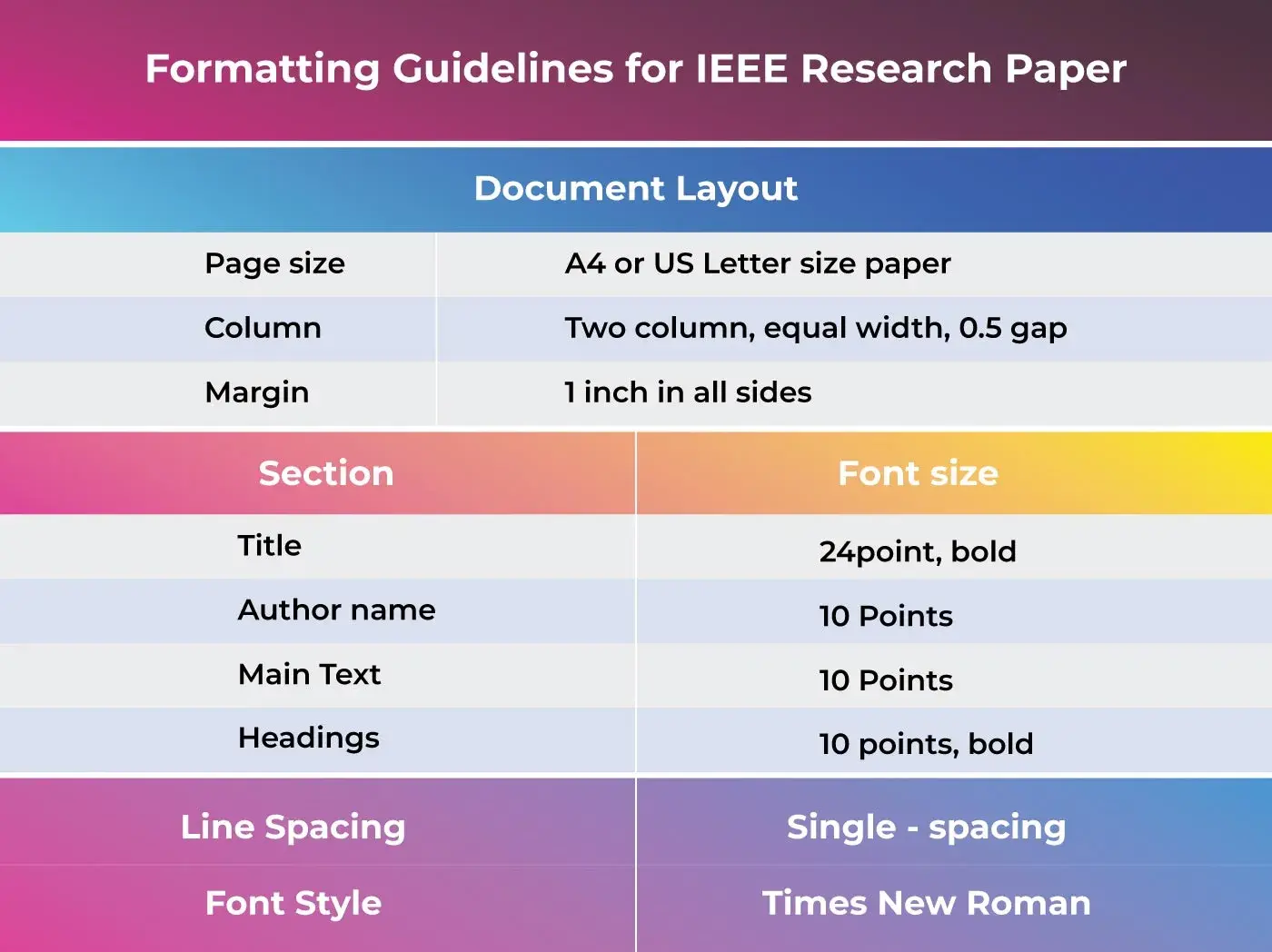
Font and Size: Use a standard font such as Times New Roman, 10-point size for the main text. Headings can be slightly larger or bolded.
-
Margins: Maintain 1-inch margins on all sides of the page.
-
Text Alignment: Justify the main text, ensuring a neat and uniform appearance.
-
Columns: IEEE papers typically use a two-column layout, except for the title, abstract, and references.
-
Headings: Use numbered headings (e.g., 1. Introduction, 2. Literature Review) and subheadings for clear organization.
-
Figures and Tables: Place figures and tables close to where they are referenced in the text. Each should have a sequential number and descriptive caption.
-
Equations: Number all equations sequentially and place equation numbers on the right-hand side of the page.
-
Page Numbers: Usually omitted in the final submission for IEEE publications.
Citation in IEEE Format
Citations in IEEE format are numeric and correspond to a numbered reference list at the end of the paper.
In-text Citation Example:
“Recent studies on renewable energy sources have shown significant efficiency improvements [1], [3], [5].”
Reference List Example:
-
J. K. Author, Title of Paper, Journal Name, vol. 10, no. 3, pp. 45-50, 2020.
-
A. B. Author and C. D. Author, Title of Conference Paper, Proceedings of XYZ Conference, pp. 12-18, 2019.
By using numbers instead of author names, the IEEE citation style keeps the text uncluttered and emphasizes the flow of ideas.
Common Mistakes to Avoid
Even experienced researchers can make mistakes when preparing an IEEE format research paper. Here are some common pitfalls:
-
Improper citation numbering – Always ensure that in-text citations correspond correctly to the reference list.
-
Inconsistent formatting – Pay attention to font, margins, spacing, and heading styles.
-
Overloading visuals – Use only necessary figures and tables; overcrowding can confuse readers.
-
Ignoring guidelines for equations – Misnumbered or misaligned equations can reduce readability.
-
Weak abstract or conclusion – Both sections are critical for capturing the reader’s attention and summarizing your research effectively.
Tips for Writing a Successful IEEE Format Research Paper
-
Plan your structure – Outline your sections before you start writing to maintain logical flow.
-
Use clear and concise language – Avoid unnecessary jargon; clarity is key in technical writing.
-
Proofread carefully – Errors in formatting, grammar, or citations can affect publication chances.
-
Incorporate relevant keywords naturally – Besides using IEEE format research paper in the first paragraph, include related terms throughout for SEO and academic clarity.
-
Check journal-specific guidelines – While the IEEE has a standard format, individual journals may have additional requirements.
Benefits of Using the IEEE Format
Adhering to the IEEE format provides several advantages:
-
Professional appearance – A well-formatted paper enhances credibility and readability.
-
Consistency – Uniform citation and formatting make it easier for readers to follow.
-
Recognition – Many engineering and technology journals require IEEE formatting, ensuring acceptance.
-
Efficient referencing – Numeric citations simplify managing multiple sources in technical papers.
Conclusion
Writing an IEEE format research paper may seem challenging at first, but with proper guidance and careful attention to structure, citations, and formatting, it becomes a manageable task. By following the guidelines outlined in this article, researchers can produce clear, professional, and publication-ready papers suitable for IEEE journals and conferences. Remember, consistency, precision, and clarity are the hallmarks of a successful IEEE research paper, and mastering these elements can significantly enhance the impact of your research in the academic and professional community.